Arizona
Southwest drop-off point
For approved cargo that can be consolidated into scheduled U.S.-to-Ukraine shipments.
HUCUS is the U.S. nonprofit logistics bridge that turns donated supplies into delivered aid. We coordinate intake, compliance, freight, and last-mile handoff for humanitarian shipments from American donors. Our active flagship corridor today serves Ukrainian hospitals.
Two ways in: deliver to one of our coordination points, or ask us to arrange pickup at your address. Either way the cargo joins the same documented shipment.
HUCUS coordinates a U.S. warehouse network for approved humanitarian cargo moving toward Ukraine. These locations function as drop-off and consolidation points: cargo is received, grouped, documented, and prepared for a larger shipment.
New Jersey remains the flagship logistics hub because of its access to Port Newark, JFK air cargo, and the Elizabeth container yard. Additional U.S. points help donors and partners route cargo into the same documented shipping workflow.
Exact delivery instructions are shared only after coordination with the HUCUS logistics team, so every drop-off is matched to cargo type, timing, and compliance requirements.
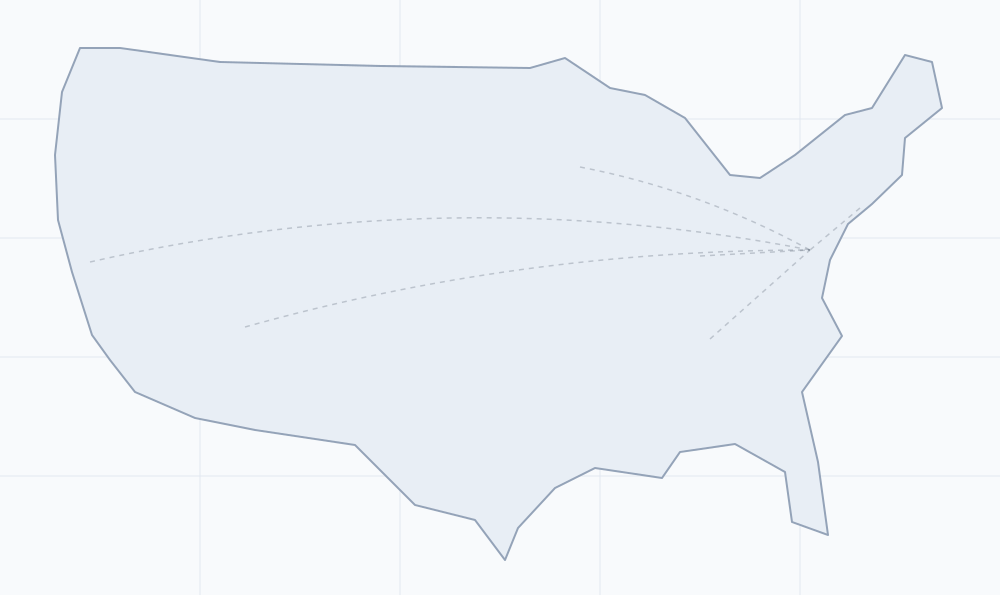
Your cargo does not have to reach New Jersey on its own. HUCUS coordinates pickup through our carrier and partner network anywhere in the United States, consolidates at our New Jersey warehouse, and moves the shipment to our receiving partners in Ukraine — one manifest, one chain of custody, one point of contact.
Southwest drop-off point
For approved cargo that can be consolidated into scheduled U.S.-to-Ukraine shipments.
Midwest consolidation point
A practical Midwest routing point for institutional donors and partner organizations.
Regional consolidation point
Supports grouped cargo movement from nearby donor and partner networks.
West Coast drop-off point
A West Coast routing point for donors and partners consolidating cargo before the New Jersey handoff.
Mid-Atlantic drop-off point
Supports grouped cargo movement into the New Jersey hub from the Philadelphia area.
NYC-metro drop-off point
A New York City routing point for institutional donors and partner organizations.
Flagship logistics hub
Primary East Coast hub for intake, documentation, consolidation, and port handoff.
Nationwide pickup service
No point on the map to bring cargo to? We arrange pickup at your address anywhere in the U.S. through our carrier and partner network.
Humanitarian logistics is the discipline of moving aid — medical supplies, medicine, equipment — from donor countries to recipient institutions under active crisis conditions. It blends customs compliance, export-control screening, cold-chain handling, freight coordination, and last-mile verification into one regulated workflow.
The stakes are concrete: a single delayed container of insulin or surgical kits can put a regional hospital on rationing within days. The World Economic Forum flagged humanitarian supply chains in Ukraine as a 2025 priority because most charitable donors lack the compliance infrastructure to ship medical cargo at scale.
HUCUS was built as a 501(c)(3) specifically to close that gap: an American nonprofit with the warehouse, the export-control procedures, and the in-country receiving partners to make institutional-grade humanitarian shipments routine.
World Economic Forum — humanitarian supply chains in Ukraine
Every shipment HUCUS handles moves through the same six checkpoints. Nothing leaves the warehouse until the prior step is cleared and documented.
Every donor organization is screened against the U.S. Treasury OFAC SDN list. Cargo type is checked against BIS export-control rules. We confirm each shipment falls within the relevant OFAC general licenses (including GL 27 and GL 18 for medicine and medical devices) before anything books into our warehouse.
Donations are received at our Port Reading and Roselle hubs. Medical devices that require cold-chain or controlled storage are handled per manufacturer spec. Inbound inspection flags damage, repackages where needed, and tags items for the manifest.
Items are consolidated into pallet- or container-level loads. Each shipment gets a full manifest, chain-of-custody record, and tax-exempt documentation. Nothing ships without an auditable paper trail.
We move cargo through vetted freight carriers — Hapag-Lloyd is our primary ocean partner; air-cargo moves through JFK when transit time matters more than cost per pallet. Insurance, customs paperwork, and port-of-entry filings are all prepared before the container leaves the dock.
At the Polish border, cargo passes to vetted in-country partners — Help Ukraine Center (Poland) and SPIVDIA coordinate onward movement into Ukrainian territory. They handle Polish customs, Ukrainian import clearance, and dispatch to the destination hospital network. Hospital distribution inside Ukraine runs through SPIVDIA Foundation and Korporatsia Monstriv — both named in our public cargo reports.
Regional hospitals sign for receipt at the dock. Signed proof-of-delivery forms return to HUCUS and to the originating donor. Named recipients publish to our impact reports within the quarter.
HUCUS ships institution-to-institution. The four partner tiers below cover nearly every humanitarian logistics request that reaches us.
Hospital networks, relief organizations, and international NGOs shipping U.S.-sourced medical aid into Ukraine.
Example: Project C.U.R.E. coordinated medical equipment consolidations.
Direct bilateral shipments between a U.S. hospital system with surplus supplies and a named Ukrainian receiving hospital.
Example: Boston Children's Hospital pediatric equipment transfers.
In-kind inventory donations (medical devices, wound-care products, generators) and matched-freight CSR sponsorship.
Example: Corporate CSR partners underwriting container-level moves.
Grant-funded shipments where a foundation underwrites a specific program area (trauma care, pediatrics, cold-chain medicine).
Example: Grant-funded neonatal and pediatric equipment consolidations.
Every HUCUS shipment sits inside a regulated U.S. export-control regime. Our shipments are screened for coverage under applicable OFAC general licenses, including GL 27 (authorized humanitarian activity) and GL 18 (agricultural commodities, medicine, and medical devices). BIS export-control rules apply to dual-use medical devices, and we screen every item before it boards a container.
SDN screening is mandatory at intake — no waivers, no exceptions. Donor organizations, recipients, and named partners are all checked. HUCUS itself is a U.S. 501(c)(3) public charity. Our EIN is 88-3438463. Form 990 is public.
If you are evaluating HUCUS for a major corporate or foundation partnership, our trust page has the deeper compliance stack: registered states and third-party ratings.
We do not publish a public rate card. Neither does any peer operator at our tier — not Project C.U.R.E., not MedShare, not Americares. The reason is structural: humanitarian shipping cost varies by cargo type, cold-chain requirements, port pairing, and freight-market conditions on the week the container books. A static rate card would misrepresent the real cost.
What we do publish in the quote you receive: shipping cost per pallet or per container, a transparent cost-sharing model for multi-donor consolidations, and the tier structure for repeat partners. Quotes are itemized; nothing is rolled into opaque fees.
A critical compliance note: payments for logistics services are fees for services rendered, not tax-deductible charitable contributions. That distinction is drawn by the IRS and we respect it on every invoice.
Ukraine only. HUCUS ships U.S.-sourced medical and humanitarian aid into Ukraine exclusively at MVP. Future destinations are evaluated but not announced until a facility and in-country partner are signed.
Medical supplies, medical devices under OFAC General License 18, wound-care products, hospital equipment, and non-medical humanitarian cargo that meets BIS rules. We do not ship weapons, defense articles, or any cargo that requires a defense export license.
Ocean-freight shipments typically transit 4–6 weeks door-to-door; air-cargo typically 5–10 days. Your quote includes a shipment-specific transit estimate based on cargo class, port pairing, and in-country handoff.
Cold-chain handling is evaluated case-by-case. We accept cold-chain medical cargo only when the donor, origin, and destination meet chain-of-custody and temperature-logging requirements. Cold-chain adds cost, itemized in the quote.
Four items: (1) SDN-clear organizational status, (2) donor-organization details, (3) named destination hospital or NGO, (4) preliminary manifest. Our team finalizes the manifest with you before intake.
In-kind donations to HUCUS may be deductible to the fullest extent of U.S. law. Consult your tax advisor. See our ways-to-give page for the in-kind procedure.
Yes. Corporate sponsors underwrite specific containers through our CSR / matched-freight program. See the partner page for program details.
Help Ukraine Center (Poland) is our primary Polish-border coordination partner. Inside Ukraine, we work with SPIVDIA Foundation and Korporatsia Monstriv for hospital distribution. Additional partners are added as programs scale.
Every shipment closes with a signed proof-of-delivery from the receiving hospital. Named recipients, volumes, and destinations publish to our quarterly impact reports.
We primarily work with U.S. 501(c)(3) organizations and U.S.-domiciled corporate donors. Non-U.S. organizations are evaluated case-by-case against our compliance requirements — contact us with your organization details to start the review.
No. HUCUS ships institution-to-institution only. Individual recipients are not part of our model.
Submit a logistics inquiry with your organization, cargo class, and destination. Our team responds within two business days with a pricing envelope and compliance checklist.
Start with a logistics inquiry. We respond within two business days with a pricing envelope, compliance checklist, and transit estimate.